In development · early access

The game engine for AI agents

Your agent builds the level, runs the physics and sees what happened. It finds and fixes its mistakes before you open the build. You make the one call that matters: is it fun?

Real physics from the engine: Super Duper Engine simulated both tests, and your browser only plays them back.

Games

Three games, three agents

Each game was made by one agent from a short brief, with no human involved. Games like these are what agents will build on SDE. Play right in the browser, nothing to install.

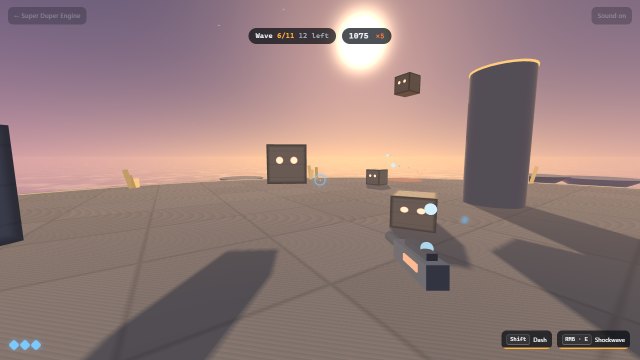
Over the Edge: a first-person view of bots on a floating island
3D shooter

Over the Edge

Knock the bots off a floating island before they knock you off. Eleven waves, about seven minutes.

Made by
Claude Opus 5.5
What you do
Shots push bots back. Drive them over the edge, chain knockoffs for combo points, sidestep the lunges, use the shockwave when surrounded. A shotgun drops after wave 7.
Controls
WASD move, mouse aim, click shoot, Space jump, Shift dash, E or right click shockwave. Phone: stick, drag to aim, buttons.
Time
13 min + ~45 min of polish
Tokens
64k + ~70k written · 13.5M + ~9M read
Play
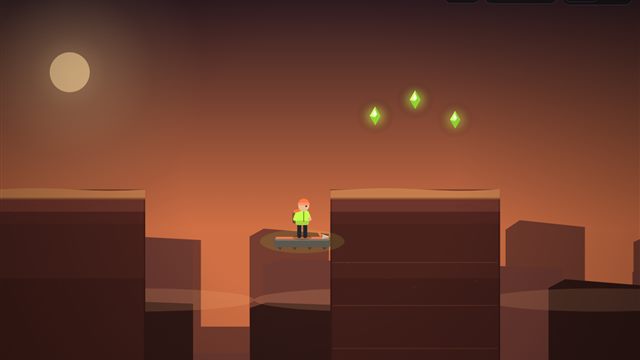
Landslide: the climber stands on a wedge stuck in a canyon wall
Ground platformer

Landslide

The ground collapses behind you. Run to the safe valley through five lands, about five minutes.

Made by
DeepSeek V4.1 Flash
What you do
Throw your one wedge into rock to make a ledge, climb it, call it back and throw again. A glowing crack shows where to throw. Every 10 crystals bring back a heart.
Controls
A/D or arrows run, Space or W jump, click or J throw the wedge, K or right click call it back. Phone: left side runs, right side jumps and throws.
Time
46 min
Tokens
309k written · 13.1M read
Play
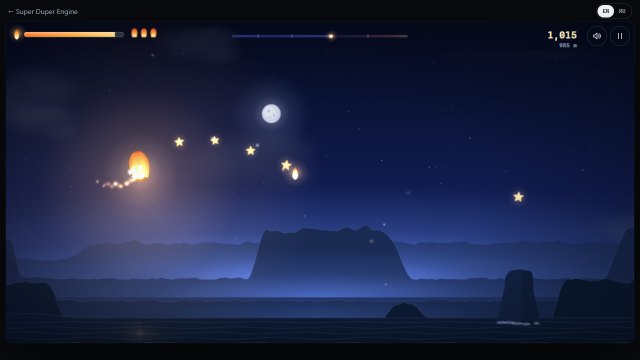
Sky Lantern: a paper lantern flies at night over sea cliffs
Air

Sky Lantern

A paper lantern drifts through one night, from dusk to dawn.

Made by
Claude Sonnet 5.5
What you do
Hold to rise, let go to sink. Catch embers to keep the flame alive until dawn.
Controls
Space, Up arrow, mouse or touch: hold. M mutes, P pauses.
Time
77 min
Tokens
470k written · 48.2M read
Play

Time and tokens cover the first playable version; for Over the Edge the polish after player feedback is shown on its own. Opus's read count runs high: it worked inside a long session.

Why

What makes SDE different

Your agent sees the game, not screenshots

Regular editors are built for eyes and a mouse. There an agent gets pictures and long object dumps, and has to guess.

In SDE the agent asks the engine directly: where things are, what hit what, whether the goal was reached.

Checks cost almost nothing

In a regular engine every question goes through a bridge to the editor and back. Checks are expensive, so the agent checks less and mistakes pile up.

One command builds the scene, runs it without a window and returns a short result. The agent checks every change and hands you a level that already works.

A passing test means it works

When physics plays out a little differently on every run, a test passes one time and fails the next, and a pass proves nothing.

In SDE the same input gives the same result on any machine and in the browser. A test that passed once passes again.

How it works

How a level gets made

You set the goal

Say what should happen: the ball knocks the crates down, the tower stands for ten seconds.

The agent builds and tests

It edits the level, runs the physics and reads the result until the test passes. It doesn't need you for that.

You play and decide

Open the level in the editor and play. If something feels off, press Report: the agent gets that exact moment of the game.

Devlog

Built in public

What's new in the engine, in short notes.

FAQ

Questions

Can I try it now?

Not publicly yet. We are opening early access to a few teams first. Write to info@superduperengine.top and tell us what you are making.

Which agents does it work with?

Any AI agent that can run terminal commands: Claude Code, Codex, Cursor and others. No MCP server, plugin or bridge: the agent talks to the engine through plain commands and spends no tokens on a middleman.

Is it built on Unity or Godot?

No. It's a separate engine with its own C++ core, Jolt physics and WebGPU rendering, designed for agents from day one.

Do I need a powerful computer?

No. The engine targets graphics cards from around 2011 onward, and it also runs in the browser.

Early access is open for a few teams

If you make games with AI agents, write to us. We'll help with your first project, and your requests go straight into the roadmap.